

The Science of Functional Training: Move Better, Live Better
At I’M HEALTHY, we’re passionate about equipping your body and your space with tools that empower your health and performance. Whether it’s a home gym, studio setup or functional training corner, we believe exercise should translate into everyday life. That’s where functional training comes in and in this post, we’ll explore the science behind it, why it matters, and how you can put it into action.
What Is Functional Training?
Functional training refers to exercises designed to mimic or replicate real-life movements pushing, pulling, twisting, squatting, hinging, balancing rather than isolating single muscles in artificial machines. The goal is to develop strength, stability, coordination, and mobility in ways that directly benefit daily activities: lifting a box, playing with children, climbing stairs, reaching overhead, or carrying groceries.
Unlike traditional bodybuilder-style isolation (e.g. machine leg curl, preacher curl) or single-joint exercises, functional training emphasizes compound movement patterns, multi-muscle engagement, and movement in multiple planes (forward/back, sideways, rotational).
The Science Behind It
Functional training isn’t just a fitness buzzword, it rests on solid physiological, biomechanical, and neurological principles.
- Kinetic Chain & Integrated Movement
Your body is connected. Movement in one joint or segment often involves muscle activation in upstream and downstream joints (e.g. ankle, knee, hip, spine, shoulder). In functional training, we think in terms of the kinetic chain – how force travels through bones, joints, muscles, fascia.
When you perform a squat-to-overhead press, for example, the legs generate force that travels through the core into the upper body. Training in isolation might neglect these connections. Functional training aims to strengthen that transmission path, improving efficiency and reducing injury risk.
- Neuromuscular Adaptation
A big part of functional training’s benefit comes from improved neuromuscular coordination: the nervous system’s ability to recruit the right muscles at the right time, in the right sequence.
When you perform integrated, multi-joint, multi-plane movements (e.g. a lunge with rotation), your body learns to stabilize, balance, and coordinate more naturally. Over time, this decreases “wasted” movements and improves movement economy.
- Joint Stability, Mobility & Injury Prevention
A functional approach doesn’t just aim to make you stronger – it also pays attention to your joints’ ability to move freely (mobility) and resist unwanted motion (stability). Many injuries occur when joints move beyond their safe ranges or when stabilizing muscles fail to control movement.
Thus, good functional protocols include:
- Core & trunk stability (to protect the spine and transmit force)
- Scapular / shoulder stability and control
- Hip, ankle, thoracic spine mobility
- Balance / proprioceptive challenges (unsteady surfaces, single-leg, etc.)
By training these alongside strength, you develop more resilient movement patterns.
- Specificity & Transfer
In sports science, the principle of specificity says adaptations are specific to the type of stress placed on the body. Functional training, by simulating everyday or sport-relevant movements, tends to transfer better to real life. Lifting heavy on a Smith machine may build leg strength, but it doesn’t necessarily improve your ability to stand up from the floor carrying a load while turning your torso.
In short, functional training tries to close the gap between the gym and life.
How to Build a Functional Training Program
Here are practical tips to bring the science into your workouts:
- Start with Movement Patterns
Include foundational patterns: squat, hinge (deadlift / hip extension), push, pull, lunge, twist/rotation, gait/locomotion (walking, running), and carry. - Progress from Stability to Strength to Power
- Begin with low-load, high-control versions to ingrain correct movement and stability (e.g. bodyweight or light dumbbells).
- Progress to heavier loads, more volume, and varied angles.
- Eventually incorporate dynamic, explosive work (medicine ball throws, kettlebell swings, jump lunges) as coordination allows.
- Include Multi-plane Movement
Don’t restrict to just forward/back motion – train lateral lunges, rotational med ball throws, side planks, etc. - Unilateral / Asymmetrical Training
Single-leg or single-arm work helps correct imbalances, force your core to stabilize, and better simulate real-world demands (e.g. picking up a heavy object with one hand). - Core Integration & Anti-movement Training
Rather than “abs isolation,” train the core in resisting motion (anti-flexion, anti-rotation, anti-lateral flexion) while the limbs move. - Conditioning & Endurance Contexts
Functional training can also include metabolic, circuit-style, or HIIT formats, where movement quality under fatigue is emphasized (e.g. sandbag carries, sled pushes, burpee variations). - Recovery, Mobility & Regeneration
Functional training demands good joint health, mobility work (foam rolling, stretching, dynamic mobility drills), and recovery strategies to avoid overuse or breakdown.
Why It Matters – Benefits You’ll Feel
- Better everyday performance: lifting, carrying, reaching, twisting become easier
- Reduced injury risk: stronger stabilizers, more balanced movement
- Improved core strength + spinal integrity
- Greater movement efficiency & coordination
- Sport-specific carryover (for athletes)
- Enhanced functional aesthetics – strength that looks and works (not just “bulky but useless”)
How I’M HEALTHY Supports Your Functional Journey
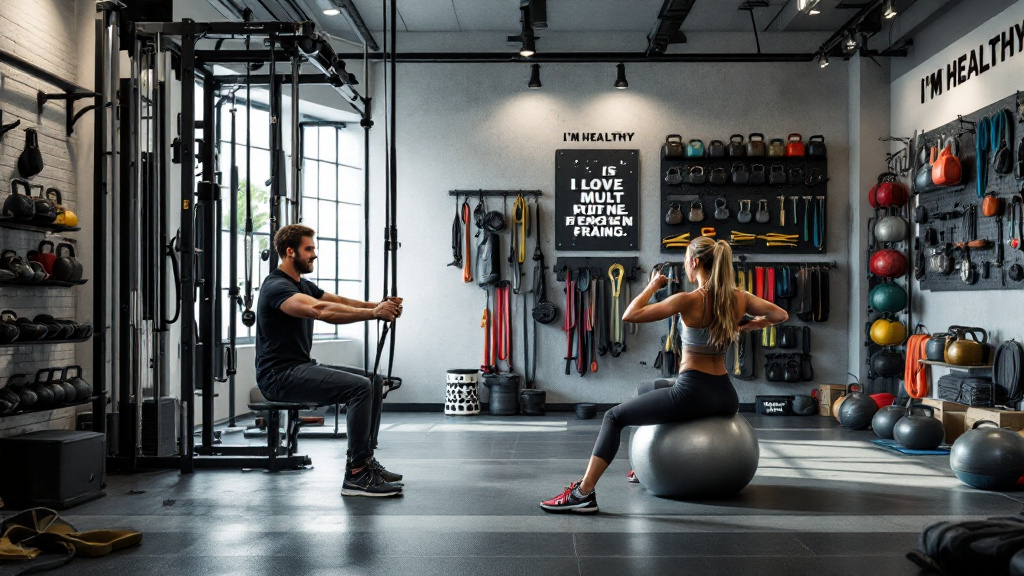
At I’m Healthy, we know that to train functionally, you need the right tools. That’s why we offer a wide selection of functional fitness equipment – kettlebells, resistance bands, cable & suspension trainers, sandbags, battle ropes, multi-functional rigs, free weights, flooring, rigs and more. (You can browse our functional category on the site.) I’m Healthy
Whether you’re outfitting a home studio or upgrading your commercial gym, our gear is selected for durability and usability – to support the kind of movement you’ll actually use in life.
Final Thoughts
Functional training isn’t a fad – it’s a return to training that matters. Its appeal lies in its alignment with how we live, move, and perform. The science backs it: integrated movement, neuromuscular adaptation, stability + mobility, and transfer to real life all support a functional approach.
At I’M HEALTHY, our mission is to help you not just train -but move better, live better, and thrive. Whether you’re building strength, recovering from injury, optimizing performance, or just trying to feel better in your body, functional training gives you a versatile, sustainable, and effective path forward.
Want help putting together a programme or selecting gear to support your functional goals? Let us know – we’re here to help you engineer your healthiest, strongest self.
